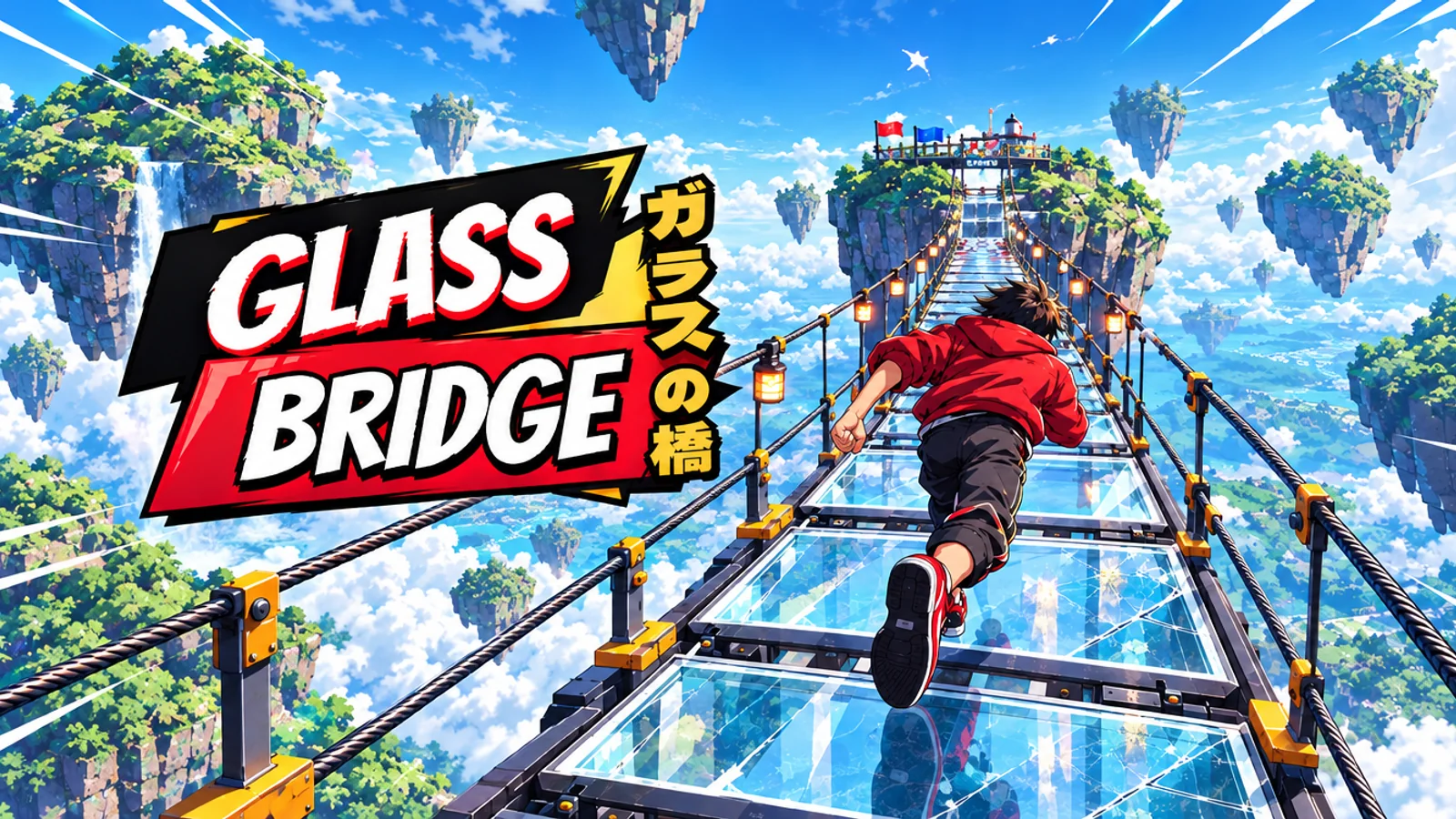
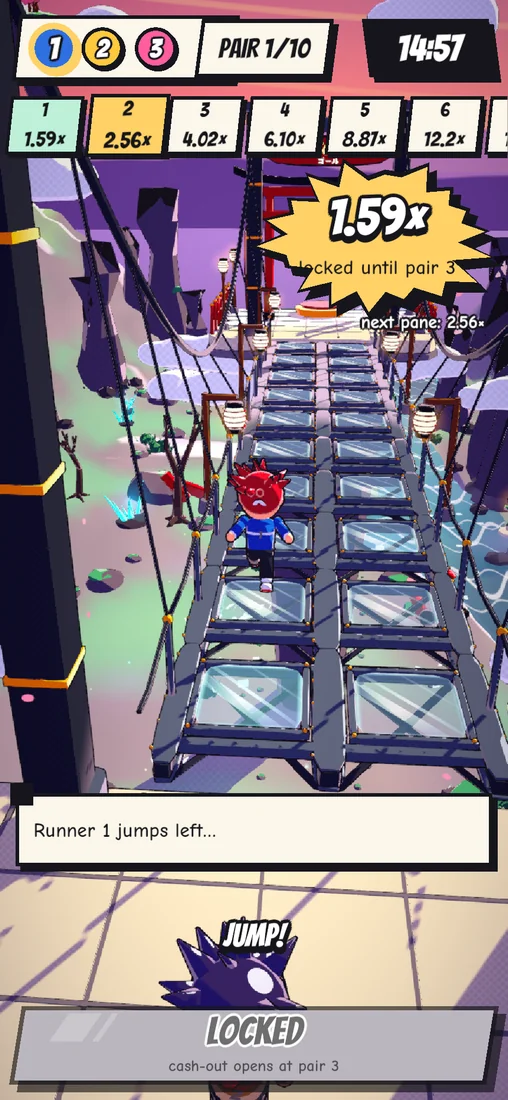
Three chibi runners stand at the edge of a gorge. Between them and the platform on the other side is a bridge made of pairs of glass panes. In every pair, one pane is tempered and the other shatters. You choose left or right, the runner at the front jumps, and either the glass holds or someone falls.
Every pane you get past raises your payout, and you can cash out whenever you like, as long as you still have runners left. The whole bridge is locked in before the first step, so every run can be checked afterwards.
Tension in every hop
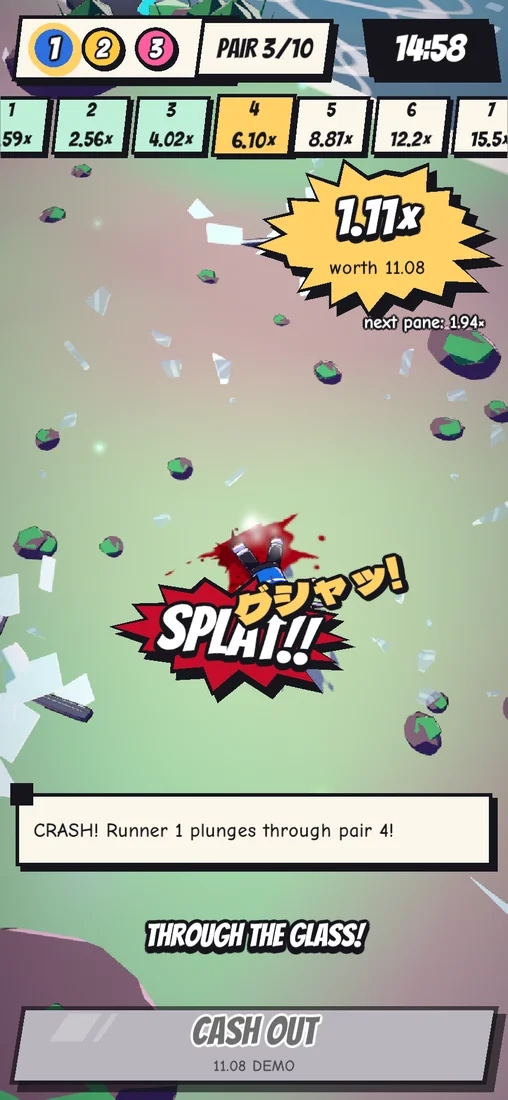
A runner in mid-air, the glass creaking, and then either a CRASH or a safe landing.
Manga energy
Speed lines, comic sound-effect lettering, a UI styled like manga panels and cherry blossoms drifting through the gorge.
Fair by construction
It returns exactly 97% at every step, and the bridge is sealed in advance so you can check it.
02Screenshots
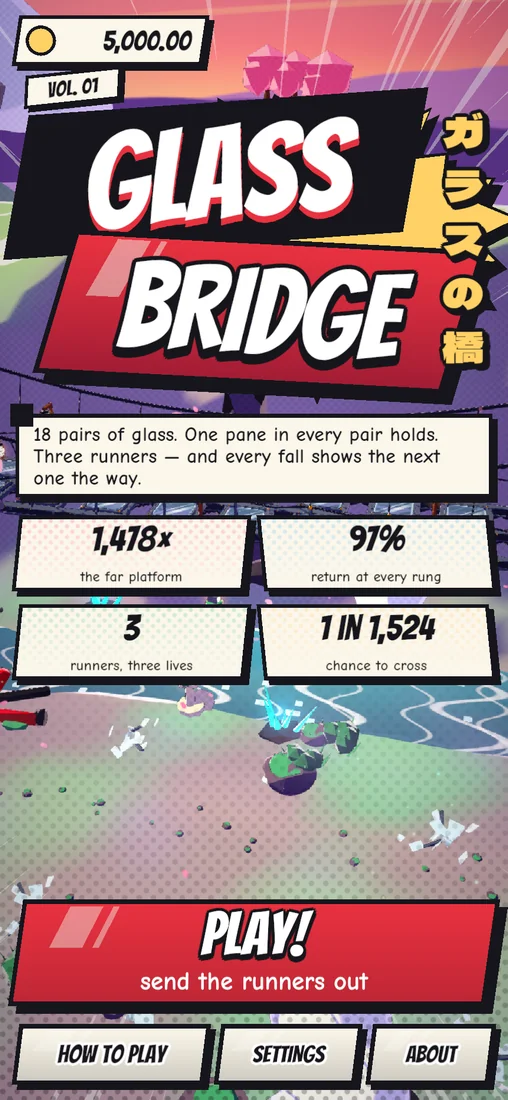
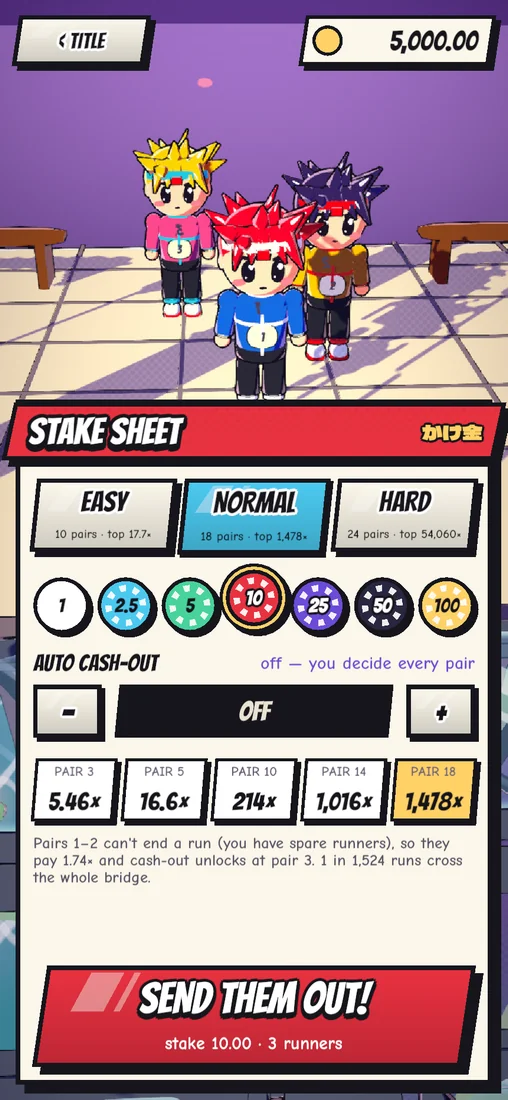
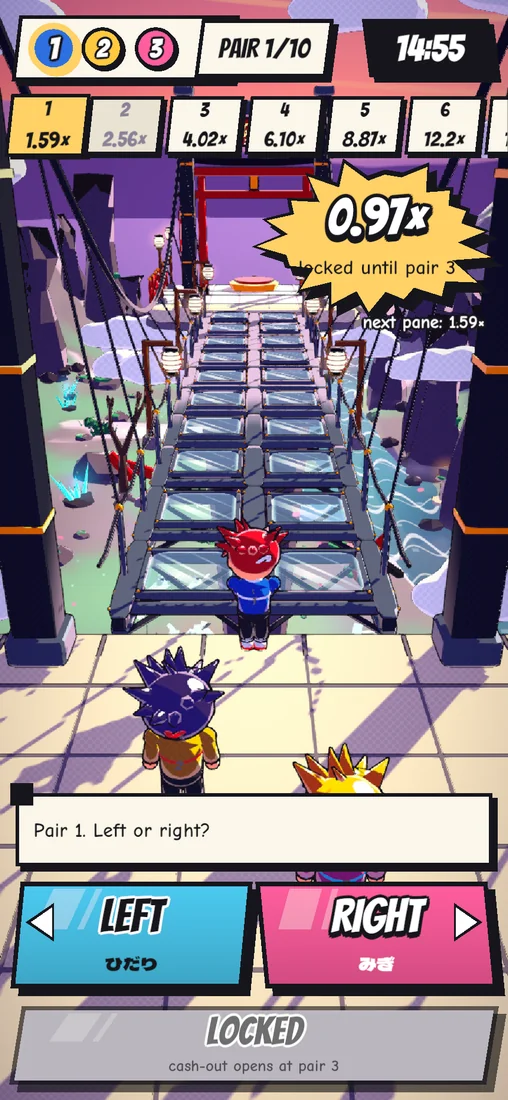
These screenshots were captured straight from the game. Tap any of them to see it bigger.
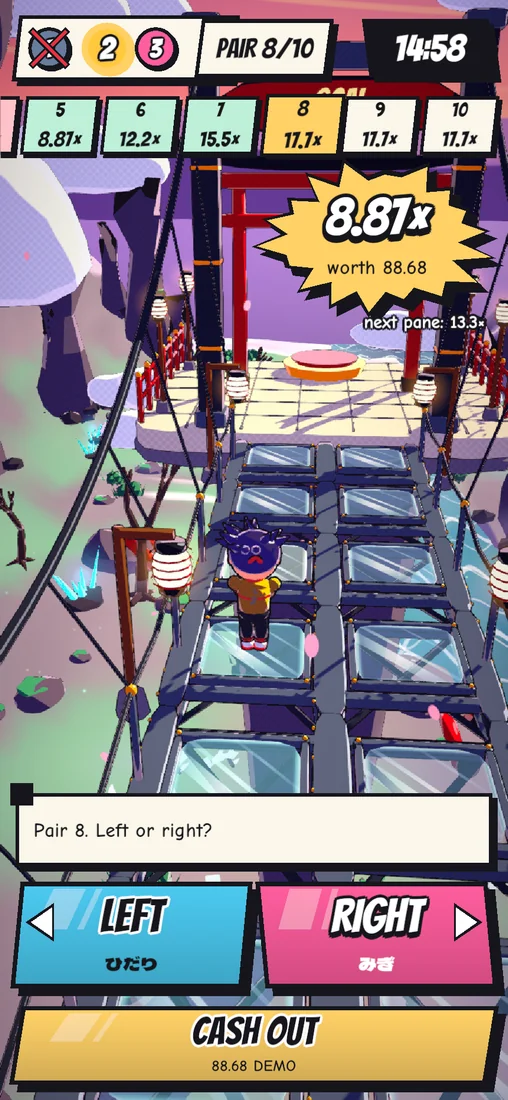
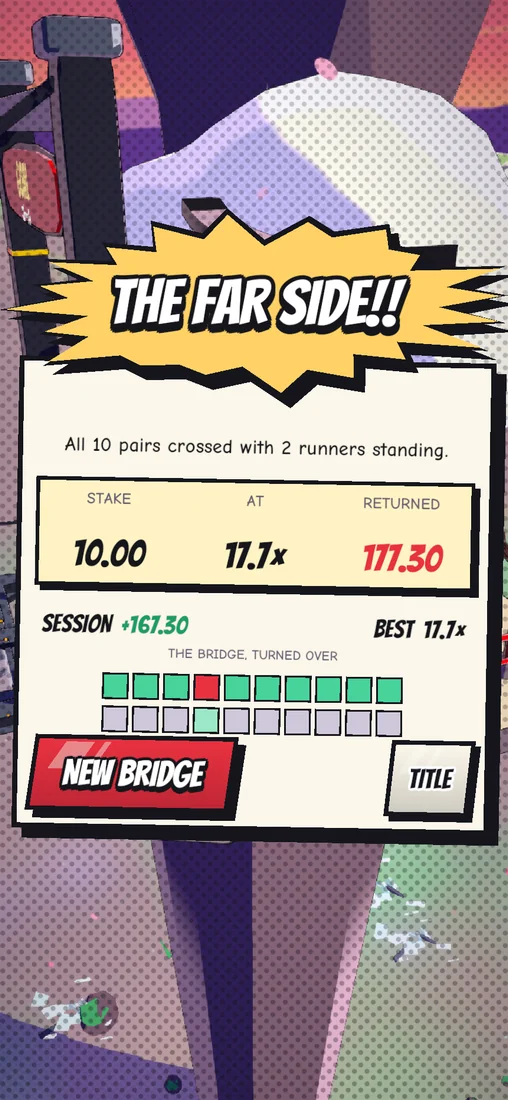
Title screenThe stake sheet - difficulty, stake and ladderPair 1 - left or right?Runner 1 jumpsCRASH - through the glassThe relay - runner 2 takes overThe far side - bridge crossed
03Core Loop
1
Stake
Choose Easy, Normal or Hard (10, 18 or 24 pairs of panes) and set your stake on the stake sheet.
2
Choose a pane
Pick left or right. Every pair is a fair 50/50.
3
Hold or fall
If it’s safe, the multiplier goes up. If it breaks, the next runner walks out onto the pane you now know is safe.
4
Cash out or cross
You can cash out from the third pair onwards, or cross every pair to win the top prize.
04Key Features
🪟
Runtime glass fracture
Panes shatter outwards from where the runner lands, breaking into real prism-shaped shards.
🏃
Procedural animation
The runners hop, squash, stretch, flail and cheer without a single pre-made animation clip.
🎌
Manga-panel UI
The UI is built entirely in code, and it rebuilds itself when you rotate the screen, fold or unfold a foldable, use split-screen or switch to a cover display.
📈
Live payout ladder
The multiplier for every step is shown on screen, and you can set it to cash out automatically at a step you choose.
⏱️
Run clock
There’s a 16-minute timer. If it runs out, your runners walk off and you’re paid at the step you’ve reached.
⚙️
Comfort settings
Options for vibration, flashing effects and gore, which are saved between sessions.
05What I Built
I made this game on my own, so I handled the design, the code, the art pipeline, the audio and the release.
I designed the game and worked out the payout maths, treating three runners as three lives, with a 97% return at every step.
I wrote all the gameplay, world and UI code in C#, and the whole game is built while it runs by a single bootstrap script.
I wrote custom Toon, Glass, Sky, Water and Particle shaders, and the glass shattering effect.
I built a procedural Blender asset generator for the runners, the bridge and the floating islands.
I built the fairness seal and the connection to the game provider.
06Under the Hood
The payout math
A run reaches pair n if it makes no more than two wrong guesses in n flips. Each step pays 0.97 divided by the chance of reaching it, cut down to four significant figures, so every cash-out point has the same 97% expected return. On Hard, the top payout is 54,060×.
Sealed bridges
The bridge layout is decided before the first step. A seed taken from a blockchain block feeds a Mulberry32 random generator, a SHA-256 commitment of the seed and layout is shown before you start, and the full draw is revealed when the run is settled.
No scene authoring
GameBootstrap builds the world, the director, the UI and the audio while the game runs, behind a manga-style loading screen. The material names are how it talks to Blender: ToonLibrary replaces each imported material with the right toon material.
Adaptive camera & UI
The camera framing adjusts to the screen shape, from tall phones to foldables and desktop windows, and the panel UI rebuilds itself when the display changes shape.
07Art & Audio Pipeline
Procedural assets
Blender/build_assets.py creates the runners, bridge, islands, spires, lanterns and props and exports them straight into the Unity project.
Shaders
Hand-written Toon, Glass, Sky, Water and Particle shaders give the game its cel-shaded manga look.
Sound & type
Koto and taiko music, sound effects from Kenney and other Creative Commons sources, and the Bangers, Comic Neue and Dela Gothic One fonts for the manga lettering.
08Challenges & Solutions
ProblemMaking a simple 50/50 choice feel dramatic every single time.
SolutionThe game asks the server for the result while the runner is still in the air. The landing waits for the answer, and if it takes a moment, you see "the glass creaks…".
ProblemPlayers can’t trust a bridge they never saw being built.
SolutionA commitment is shown before you play and a fairness card after, so the result can be worked out again and checked.
ProblemFoldable phones can change shape in the middle of a run.
SolutionThe UI is built in code, so it tears itself down and rebuilds when you rotate, fold or unfold the phone, use split-screen or switch to a cover display.
Pricing every step from one formula keeps the game honest without making it boring.
Procedural animation gave the runners more personality than pre-made animation clips would have.
Building the UI in code pays off the moment someone unfolds their phone.
Credits. The Blender assets and shaders are all original. Sound effects come from Kenney and others (CC0 and CC-BY 3.0), the music is "koto" by fx10243 and "Taiko drums" by jobro, and the fonts are Bangers, Comic Neue and Dela Gothic One (OFL). The game only uses virtual coins, and there’s no real-money betting.